


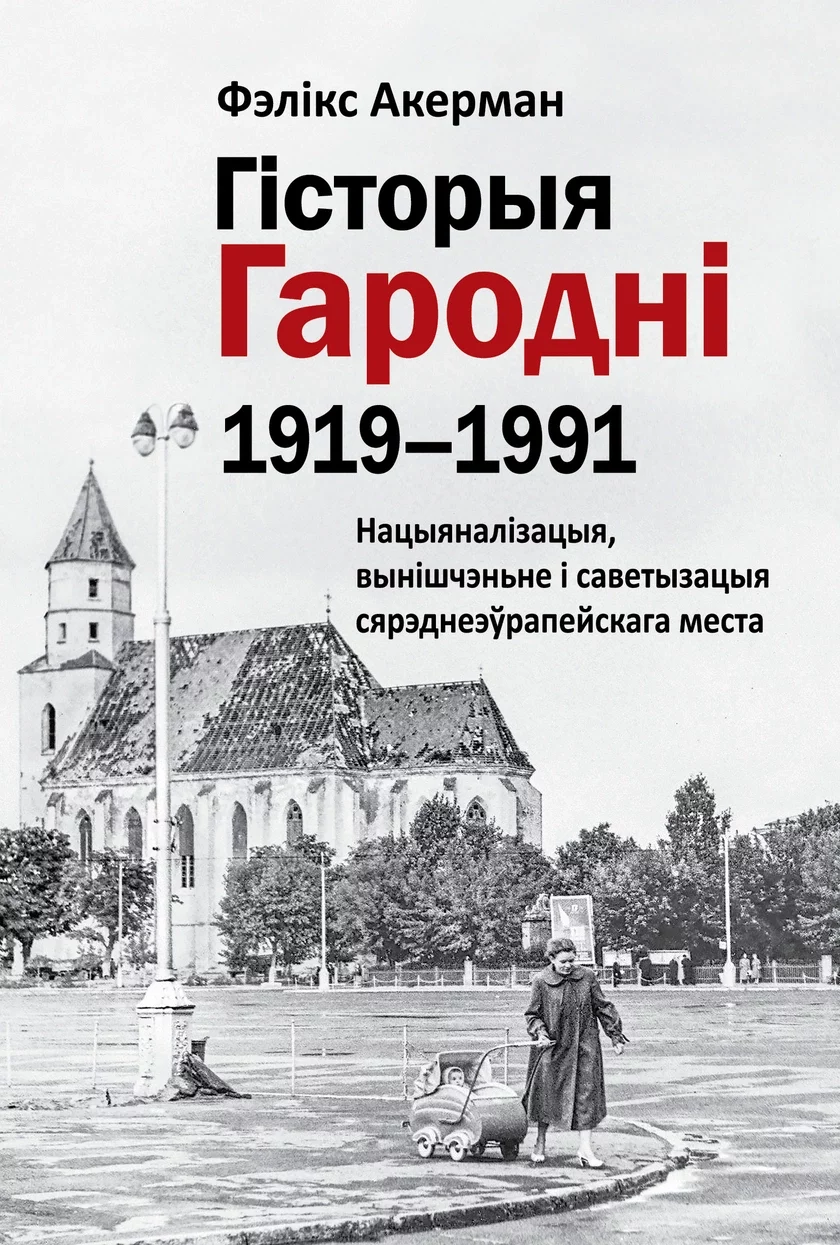
On June 9, a presentation of the Belarusian translation of the book "The History of Hrodna (1919—1991): Nationalization, Annihilation, and Sovietization of a Central European City" will take place in Warsaw, with the participation of its author, Felix Ackermann.
Felix Ackermann is a German historian and publicist, professor, and head of the Department of Public History at the University of Hagen (Fernuniversität in Hagen).
This book is an attempt to write the history of Hrodna in the 20th century from the perspective of cultural anthropology. It is based on oral accounts of Hrodna residents, archival research, and earlier historiography, which the author treats with emphasized criticism. The answer to the question of how Belarusian Hrodna emerged is given taking into account the local history of the formation of three national projects — Polish, Soviet, and uniquely Belarusian — at the intersection of three countries — Belarus, Poland, and Lithuania.
Dozens of documents and photographs are published in the book, some of them for the first time.
To prepare this book, the author interviewed dozens of local natives. Among them are Andrzej Poczobut, Professor Ales Smalianchuk, Aliaksandr Milinkevich, and local historian Aliaksandr Hostseu. The author's interlocutors included priests, anonymous teachers from Belarusian and Polish-speaking schools, and lecturers from Hrodna University. However, the book presents not only the voices of those who lived in Hrodna at the time of writing but also those who left it as part of the so-called repatriation. For this purpose, the author met with Hrodna Jews in Israel and Hrodna Poles in Poland who left after the war. He also worked with Hrodna archives, including those currently located in Poland, with multilingual periodicals, and used little-known sources from German archives about Hrodna during the occupation.
This book is about:
- Belarusian places and Belarusian figures in Hrodna during the interwar period.
- conflicts between Christians and Jews during the same period.
- the first Soviets in Hrodna (September 1939 — June 1941), which, on the one hand, brought deportations of the local population and other repressions, and, on the other hand, the Belarusianization of the education system.
- the survival strategies of Hrodna's multi-ethnic population during the German occupation and the mass murder of Hrodna Jews.
- the second Soviets and the waves of Russification and Sovietization they brought.
Time and place of the presentation:
June 9 (Tuesday), 8:00 PM.
Address: Oleandrów 6, Centrum Białoruskiej Solidarności (Belarusian Solidarity Center).





Comments